




Real-Time Automotive Parts Label Verification with iDPRT Barcode Inspection Printers
Quick Answer: The iDPRT iV Series prints and inspects automotive parts labels in a single cycle. CIS imaging, barcode grading, OCR/OCV, and MES/ERP data matching detect unreadable barcodes, incorrect data, duplicate or missing codes, print defects, and position errors before labels move downstream.
From incoming inspection to final assembly, automotive parts labels link components to OEM and supplier production and traceability systems. They carry part numbers, supplier codes, production dates, lot or batch numbers, serial numbers, and 1D or 2D barcodes. One incorrect field—or one unreadable code—can cause a rejected part or stop a workstation.
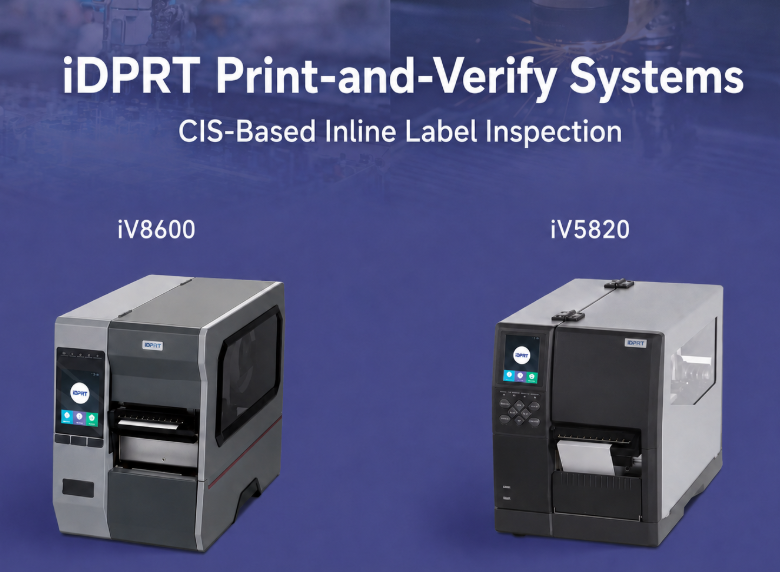
The iDPRT iV8600 and iV5820 combine thermal transfer printing with CIS inline inspection. OCR reads human-readable text, OCV verifies character presence and print integrity, and database checks compare printed and encoded data with MES, ERP, or work-order records. Labels that fail the configured inspection rules can be stopped, marked, or reprinted before use.
The iV Series is deployed in automotive plants and supplier inspection operations across China, covering labels for wiring harnesses, brake components, in-vehicle displays, EV batteries, drive motors, and power electronics.
Why Do Automotive Parts Labels Fail Inspection?
Most failures come from four sources: contamination, poor print settings, uncontrolled variable data, and inconsistent manual inspection.
1 Dust and Debris Affect Print Quality
Machining, stamping, and welding shops generate metal dust and paper debris. When particles collect on the printhead or label surface, they can cause missing dots, broken character strokes, white lines, light print, and ribbon wrinkles.
These defects are often too small for an operator to spot at production speed. A scanner is less forgiving. If the same fault appears across a batch, the OEM may reject the shipment.
2 Poor Barcode Grades Disrupt Automated Scanning
Automotive OEMs typically require barcode quality Grade B or higher, while some precision components require Grade A. Barcode quality is assessed under ISO/IEC 15415 and classified as Grade A, B, C, D, or F.
A Grade C or D label may scan on a handheld terminal but fail on an OEM’s automated production line because of insufficient reading stability. Once an OEM rejects a batch, the shipment is refused and contractual penalties are deducted. Monthly chargebacks can reach tens of thousands of U.S. dollars.
3 Duplicate or Missing Codes Break Part-Level Traceability
Under IATF 16949:2016 Clause 8.5.2.1, serialized labels link traceable automotive parts to their production and quality records through unique barcode or RFID identifiers.
Production errors can still create duplicate, missing, or incorrect identifiers:
- ● A serial sequence does not resume correctly after a power outage.
- ● An operator enters the wrong work order or serial number.
- ● Data from the previous job remains active after a changeover.
- ● A reprint is not synchronized with the serial number database.
- ● The sequence skips one or more numbers.
- ● Printed data does not match the current MES or ERP record.
If two different components carry the same identifier, the traceability system cannot reliably distinguish between them. That makes it harder to identify and contain affected parts during a recall and raises the risk of part mix-ups during assembly.
4 Manual Inspection Leaves No Reliable Audit Trail
Manual inspection can catch obvious damage, but it is unreliable for high-volume, variable-data automotive barcode labels. Accuracy declines with fatigue, standards vary by operator, and the results are often recorded on paper or in spreadsheets.
Those records rarely connect a failed label to its printer, ribbon, label stock, work order, or batch.
When an OEM reports a problem, the supplier may spend hours reconstructing what happened. For brake, steering, and other safety-critical components, that delay can widen the potential recall scope.
Why Not Use a Separate Inspection Camera?
Some automotive suppliers pair an industrial label printer with a standalone vision camera. While this adds automation, inspection still happens after printing, so multiple nonconforming labels may be produced before a defect is detected.
Separate systems also require extra mounting, lighting, controls, and integration work, while inspection results may remain disconnected from print jobs and MES/ERP records. At higher speeds, synchronization limits can make 100% inspection difficult.
An integrated print-and-verify system checks each label within the print cycle, enabling immediate action before a failed label moves downstream.
How Do iDPRT Print-and-Verify Systems Inspect Automotive Part Labels in Real Time
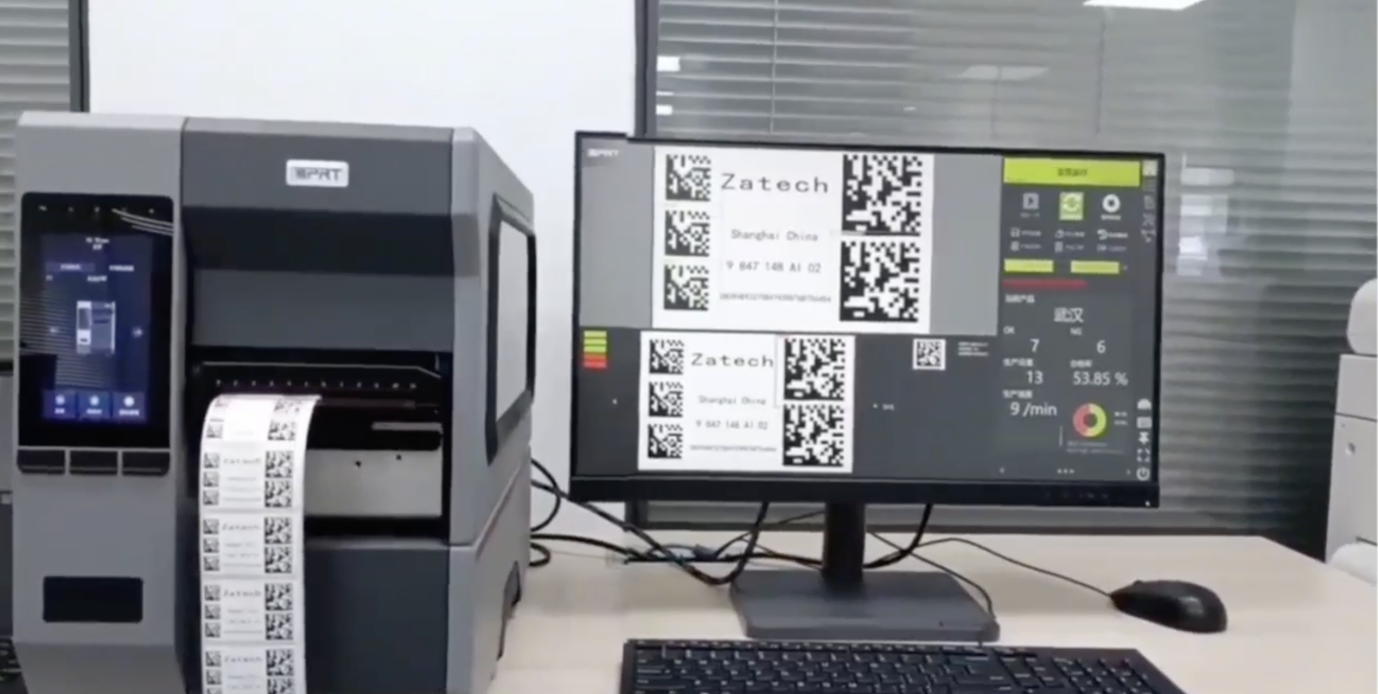
The iDPRT iV8600 and iV5820 series barcode printers with verifier combine an industrial thermal transfer print engine with our in-house-developed IVI machine vision system. A CIS-based inline imaging module captures each automotive part label as it moves through the printer, completing inspection before the label exits the device.
Inline Inspection at the Print Source
Conventional fixed scanners inspect labels after printing. By contrast, the iV Series captures each label line by line during the print cycle.
The inspection process requires no separate station or additional line cycle. It also does not reduce the printer’s configured operating speed. A failed label is identified before it reaches the application point. The system is designed for continuous, high-volume, 24/7 variable-data printing.
Label Data Verification with MES and ERP
OCR reads human-readable text, while OCV verifies character presence, integrity, and print quality. The system then compares printed and encoded data with the expected MES, ERP, work-order, or production-database record.
The print & verify solution can verify:
- ● Part numbers
- ● Supplier codes
- ● Production dates
- ● Batch and lot numbers
- ● Serial numbers
- ● Vehicle or model codes
A mismatch is flagged immediately. Work order data can be sent to the printer automatically, avoiding manual re-entry. Inspection results are returned to the host system and linked to the corresponding production record. This creates a closed loop between label data, printed output, inspection results, and part-level traceability.
Barcode Grading, Data Verification, and Defect Detection
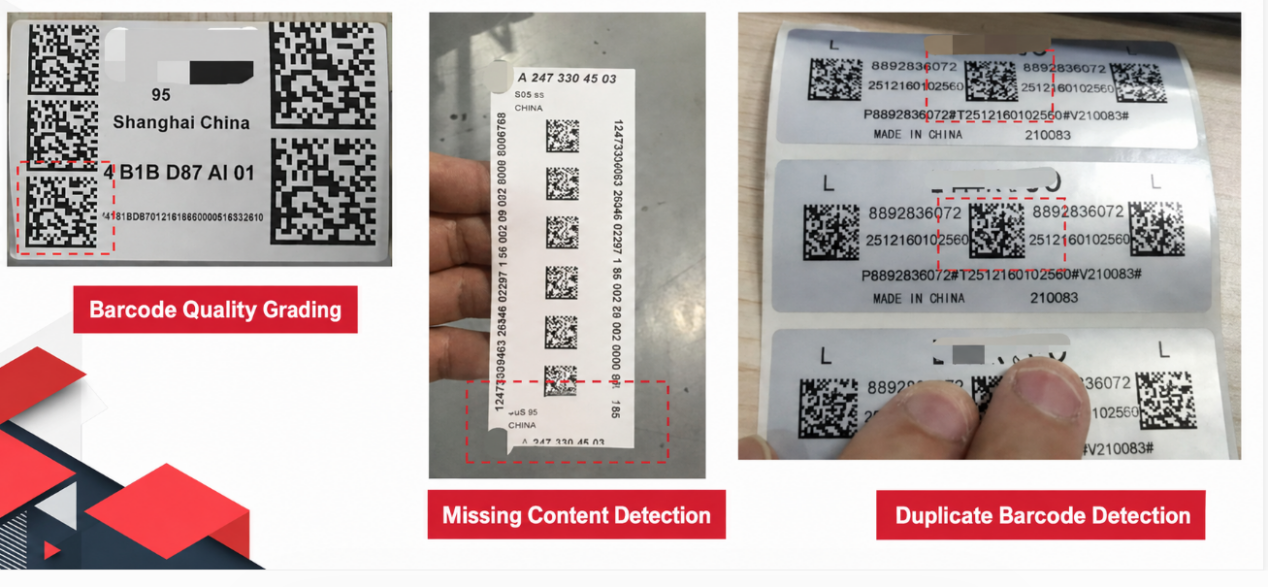
The iV Series checks the complete label—not only whether a barcode can be decoded.
- ● Barcode quality grading: Grades 2D codes against ISO/IEC 15415 and linear barcodes against ISO/IEC 15416.
- ● Duplicate and sequence checks: Detects duplicate, missing, skipped, or unexpected codes. Database-wide duplicate checking is available across print jobs.
- ● Print defect inspection: Detects missing print, ribbon wrinkles, broken character strokes, faint print, and white lines.
- ● OCR and OCV: Verifies printed text against expected data.
- ● Position inspection: Checks whether text and barcodes remain inside the specified print area.
- ● Date and serial validation: Flags invalid dates, duplicate serial numbers, skipped numbers, and out-of-sequence records.
Faster Changeovers Between OEM Label Formats
Conventional vision systems may require operators to redraw inspection regions, select barcode types, and reset parameters for each label format.
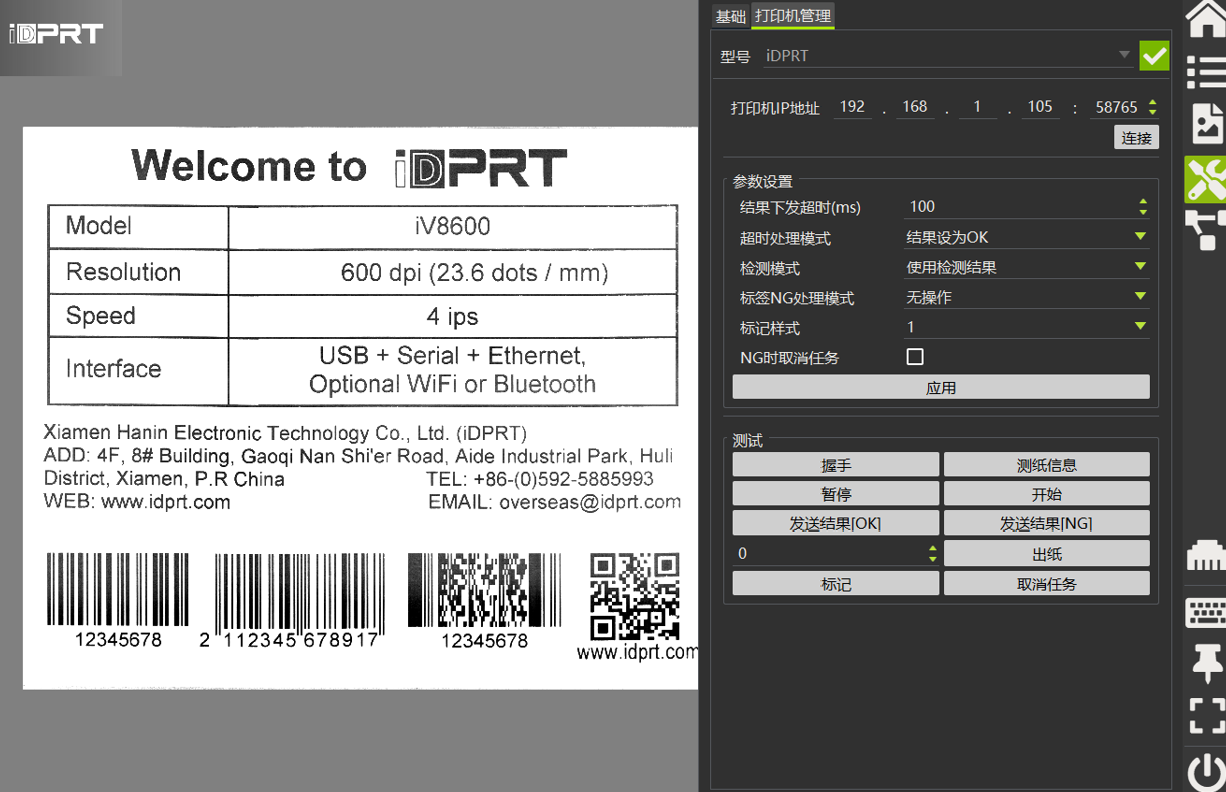
Using a captured label image, the iV Series can automatically identify barcodes, text, logos, and borders, reducing the need for manual inspection-model setup.
Templates for multiple OEMs can be stored in the system and recalled when the work order changes. Inspection logic can switch within seconds, reducing total changeover time from more than 20 minutes to less than three minutes.
Three Ways to Handle a Failed Label
Different components call for different controls. The iV Series offers three configurable modes:
- ● Stop and alert: Stops printing as soon as a failed label is detected. Best suited to safety-critical and high-value components.
- ● Backfeed and mark: Retracts and marks the failed label without stopping continuous production.
- ● Backfeed, mark, and reprint: Invalidates the failed label and automatically prints an inspected replacement.
Where Are iDPRT Print-and-Verify Systems Used in Automotive Manufacturing?
iDPRT print-and-verify systems are well suited to automotive applications where serialized data, OEM label specifications, and traceability requirements leave little room for error.
Wiring Harnesses
Database-wide duplicate checking, multi-field OCR, and inline inspection help prevent duplicate serial numbers, part mix-ups, and label misapplication.
Chassis and Brake Components
Every automotive barcode label can be checked against a Grade B-or-higher threshold. The system also detects defects on heat-resistant labels and compares printed data with MES or ERP records. These controls support traceability requirements for safety-critical components.
Interior and Exterior Trim
Automatic recognition of barcodes, text, logos, borders, and color codes—combined with position inspection and stored OEM templates—helps support mixed-model production with faster changeovers and less manual setup.
Automotive Electronics and In-Vehicle Display Modules
Barcode grading and serial number verification protect high-value electronic components. Stop-and-alert mode prevents a failed label from moving to the next process.
EV Battery, Motor, and Power Electronics Systems
Barcode grading, duplicate detection, print defect inspection, and MES reporting support traceability from cell to module, battery pack, and finished vehicle. Offline inspection can also recheck printed labels before inventory receipt.
How Does iDPRT Support Deployment and MES Integration?
Deploying a print-and-verify system involves more than replacing a printer. Inspection logic must be configured to match the label format, OEM label specifications, and production systems already in use.
iDPRT provides end-to-end deployment support, including:
- ● Site assessment: Reviews the line layout, label specifications, OEM requirements, and existing print equipment.
- ● Template and inspection setup: Imports OEM label templates and configures the required inspection parameters.
- ● MES and ERP integration: Supports automated work-order data transfer and real-time reporting of inspection results.
- ● Operator training: Provides hands-on training for production and quality teams.
- ● Preventive maintenance and support: Includes routine equipment checks, printhead cleaning, media calibration, inspection adjustment, and software updates.
Make Label Inspection the First Line of Traceability Control
Automotive label quality is the first line of defense for supply-chain compliance and part-level traceability. By combining thermal transfer printing and inline inspection in one system, iDPRT helps suppliers detect barcode, data, and print defects before labels move downstream.
Contact iDPRT for a complimentary site assessment, label-specification review, and tailored print-and-verify recommendation.
FAQs
What Barcode Quality Grade Do Automotive OEMs Require?
Grade B or better is a common acceptance threshold for automotive barcode labels, while some high-precision components require Grade A. The applicable OEM specification remains the final authority.
The iDPRT iV8600 and iV5820 grade 2D codes to ISO/IEC 15415 and linear barcodes to ISO/IEC 15416, reporting results from Grade A to F. A code below the configured threshold triggers automatic rejection or an alert.
Does Inline Barcode Verification Slow Down Printing?
No. The iV8600 and iV5820 inspect each label within the print cycle.
A CIS line-scan camera captures the label in sync with the print engine, so verification adds no separate inspection step or line takt time and does not reduce the configured print speed.
Can One Barcode Inspection Printer Handle Labels for Multiple OEMs?
Yes. The iV Series stores label templates for multiple automotive OEMs and recalls the required template when the work order changes.
One-touch image capture identifies barcodes, text, logos, and borders without manual vision-model setup. Inspection logic can switch within seconds, making the system suitable for mixed-model production and frequent job changes.
Can the iV Series Inspect Automotive Parts Labels That Are Already Printed?
Yes. Offline inspection mode batch-checks previously printed automotive parts labels using the same criteria as inline inspection, including barcode grade, data accuracy, and print defects.
It is suitable for pre-inventory checks, incoming supplier inspection, and after-sales traceability reviews. For these tasks, it can replace a conventional standalone barcode inspection station.
Can iDPRT Barcode Inspection Printers Integrate with MES or ERP Systems?
Yes. The iV8600 and iV5820 can receive work orders automatically and return inspection results to the host system in real time.
MES or ERP integration links each automotive parts label to its production record, creating a closed data loop from work order and printing to inspection and traceability. iDPRT also provides integration and commissioning services.